
Discovering a wasp nest on your property often generates a fair amount of stress. Is it dangerous? Can you get rid of it yourself? When should you be concerned? To help you react appropriately and safely, our experts have compiled answers to the most frequently asked questions from homeowners in the area.
How to recognize a wasp nest?
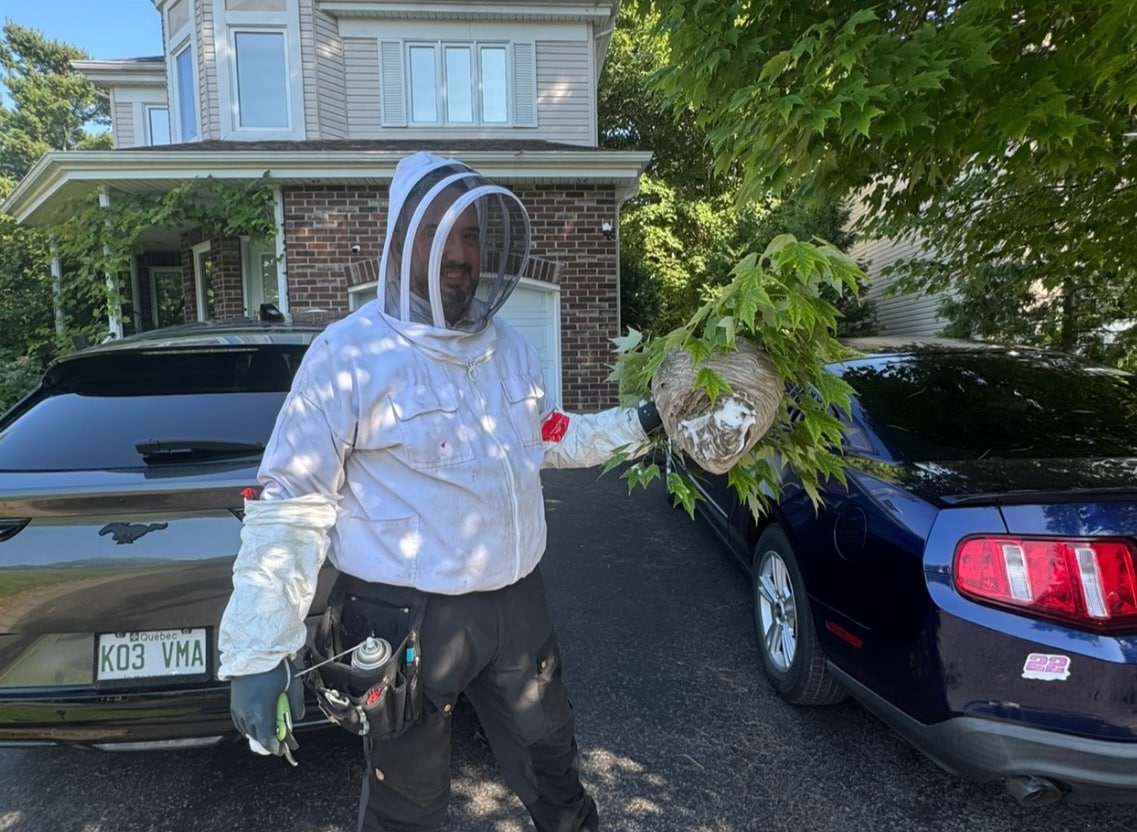
A wasp nest generally resembles a large ball of grayish paper or chewed cardboard. Wasps build this structure by chewing wood fiber mixed with their saliva.
Depending on the species, the nest can be found in various strategic locations:
Is it dangerous to destroy a wasp nest yourself?
Yes, it is extremely risky. Unlike bees, which only sting once, a single wasp can sting repeatedly without dying. When a nest is attacked, the colony releases alarm pheromones that trigger an aggressive and coordinated attack by hundreds of wasps within seconds. Without professional protective equipment (a waterproof suit), the risks of multiple stings and severe allergic reactions (anaphylactic shock) are extremely high.
When is the best time to remove a wasp nest?
The best time to intervene is in the spring or early summer. This is when the queen wasp begins building her colony; the nest is then very small (about the size of a golf ball) and contains few worker wasps. As we move towards August and September, the nest grows larger, potentially housing several thousand aggressive wasps.
Pro tip: If intervention is necessary, it should always take place at dusk or early morning, when all the wasps are inside the nest and their activity level is at its lowest.
Do wasps return to the same nest year after year?
No. Wasp nests are annual and are completely abandoned with the arrival of winter. In the fall, the entire colony dies except for the newly fertilized queens, which leave the nest to find a warm shelter (under the bark of a tree or in the attic) to overwinter. The following spring, the queen will never reuse the old nest; she will start a new structure from scratch.
What to do if a wasp nest is hidden in a wall or soffit?
If you notice wasps constantly going in and out of a crack in your brickwork or under a soffit, never block or seal the hole. If you block their only exit from the outside, the wasps will look for another way out and will eventually break through the drywall to invade the inside of your home. In this case, professional extermination by injection is required.
Why Choose Rive-Nord Extermination to Remove a Wasp Nest?
Since 1988, our family business has been providing rapid service to secure your property. Our certified technicians are equipped with full protective gear and specialized, long-range control products to neutralize colonies instantly and safely for your family.
📞 Spotted a wasp nest near your home? Contact Rive-Nord Extermination today to schedule a prompt visit from a certified technician.